Projects

The projects we work on and those we have completed are the best references for our research work. Fraunhofer SCAI is involved in numerous projects funded by the German Federal Government and the European Commission. The list below presents the projects chronologically – new projects first. You can sort the list by selecting categories.

Do you have any questions? Please feel free to write us:

marketing@scai.fraunhofer.de

Reset
  • The project KI-Lectrolyte develops new approaches for creating high-performance, safe electrolytes for next-generation batteries. By combining experimental data with simulations and AI methods, promising electrolyte formulations can be identified much faster. A central database integrates measurement data, simulation results, and AI-based predictions of material properties, enabling targeted analysis for different battery chemistries and supporting data-driven development of new electrolytes. The result is a digital tool that transforms chemical knowledge directly into technological innovation. Fraunhofer SCAI contributes its expertise in AI-driven materials research, data integration, and modeling to the project.

    more info
  • PREDICTOR – Predictive Platform for Electrochemical Energy Storage Materials

    EU-Projekt / Projektbeginn / September 01, 2024

    The Marie Skłodowska-Curie Doctoral Network PREDICTOR is developing new AI-powered methods for the fast and targeted discovery of electroactive materials for redox flow batteries. The objective is to rapidly identify promising electrolytes by integrating simulation, automated synthesis, high-throughput experimental testing, and intelligent data management. Fraunhofer SCAI contributes semantic concepts, ontologies, and AI-based prediction models that connect and exploit the wealth of project data to enable targeted material design.

    more info
  • The BASE project aims to develop the digital battery passport, which every larger battery will be required to have in the future. The passport will contain continuously collected data on the "State of Health" as well as information on the supply chain, the manufacturing process and material data. It will apply the "mass balance" method, which offers a detailed accounting of the materials used in battery production, with special emphasis on the use of sustainable components. The data from the battery passport is stored in a decentralized and tamper-proof manner so that all parties involved have access to it. This enables the optimization of battery lifespan and enhances recycling.

    more info
  • ESPINN – Explainable, AI-based simulation using Physics-Informed Neural Networks

    Fraunhofer PREPARE Project / Project start / May 01, 2024

    In the ESPINN project, Fraunhofer researchers develop new simulation methods for the semiconductor industry that combine physical laws with artificial intelligence techniques. Physics-Informed Neural Networks (PINNs) enable the calculation of complex processes, such as chemical reactions or material diffusion, up to a thousand times faster than before. Four software solutions form the backbone of the project: they simulate atomic interactions, optimize the production of metal contacts, support the photolithography of components, and at the same time assess the reliability and interpretability of the results. Fraunhofer SCAI contributes extensive expertise in physics-based simulations, machine learning, and virtual material design.

    more info
  • A sustainable circular economy is essential to achieve the goal of climate neutrality. To this end, the development of new innovative building materials is crucial. However, this development has so far been a very laborious and lengthy process. To support and significantly accelerate this process, experts from the Fraunhofer institutes IBP and SCAI develop new data-driven virtual techniques for material design at the Fraunhofer Center for Machine Learning.

    more info
  • Deep Learning for Virtual Material Design

    Project start / April 01, 2020

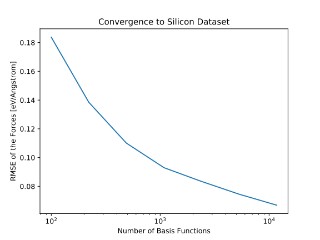
    Empirical analysis potentials and ab-initio methods such as density function theory have been the pillars of computer-aided materials science. With theoretical advances in machine learning and the rapid increase in computing power, data-based approaches have emerged a new class of models with the goal of combining the predictive power of ab-initio methods and the computational efficiency of empirical potentials. Standard machine learning techniques such as kernel learning (e.g. for the Gaussian approximation potential), deep neural networks (e.g. neural network potentials by Behler et al.), and generalized linear models (e.g. for momentum tensor potentials) have been employed to develop fast and accurate force fields from data without the need for human knowledge about the underlying chemistry. In this project we develop high-quality, easy-to-use implementations of such machine learning potentials and investigate possibilities to improve the existing approaches by utilizing modern tools from the constantly growing toolbox of data science.

    more info
  • © Fraunhofer SCAI

    MaGriDo's goal is to (further) develop and analyze deep neural networks (NNs) for industrial problems, which allow existing domain knowledge to be incorporated into the architecture of the networks. Such a hybrid approach can make use of the complementary strengths of "end-to-end" learning approaches and "a-priori models/rules". This approach promises more efficient solutions for many fields of application. For example, the amount of data required is reduced, or the predictions of the ML model are consistent with existing knowledge. The focus of research and development in MaGriDo is on so-called graph networks, since complex systems can usually be represented very well as compositions of entities and their interactions. These contain various special cases such as conventional fully-connected NN, convolution NN and recurrent NN, can be applied to relational structures, and make a hierarchical processing of input data possible.

    more info

  • SONAR – Better Batteries for Electricity from Renewable Energy Sources

    EU-project / Project start / January 01, 2020

    The project aims to digitally capture the complex processes in flow batteries in their entirety; in addition, it is about accelerating the search for new, suitable materials and optimizing the design of a battery system to specific conditions. Fraunhofer SCAI uses mathematical models to keep the search area for new substances as focused as possible, but only as large as necessary, and then to increase the throughput in the material search. For maximum reliability, the results are continuously validated with simulated and experimental reference data.

    more info
  • MultiModel

    BMBF-project / Project start / June 01, 2015

    © Fraunhofer SCAI

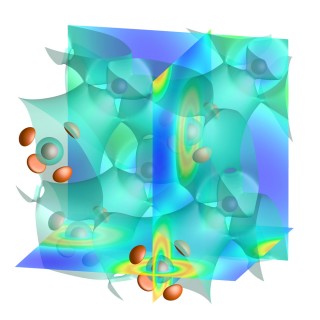
    Growth and processing of materials is an integral part of chemical and electronic engineering. As these industries are introducing nanoscale technologies the processes will require atomic-scale precision which is difficult and costly to obtain by experimental trial and error. With the newly developed tool it will be possible to simulate atomic-scale mechanisms under different process conditions, providing valuable input to the process optimization which will reduce the cost of developing new materials.

    more info
  • HBP – The Human Brain Project

    EU-project / Project start / October 01, 2013

    Logo HBP

    In the "Human Brain Project" (HBP), which is funded by the European Commission, leading research institutions work together to better understand the human brain. For that purpose the project partners will develop new simulation methods, for example on high performance computers. The project aims to develop new therapeutic approaches for the treatment of brain diseases and new methods of High Performance Computing.

    more info